Solar Panel Installation Across the North East
MCS certified, award-winning installation by ALPS Electrical. 500+ five-star reviews on Checkatrade.


Quick answer
How much do solar panels cost in 2026 in the UK?
A typical residential solar panel installation costs £5,000-£11,000 fully fitted. A 4kW system (8-10 panels) is the most popular at £5,000-£7,000, ideal for a 3-bed semi. A 6kW system is £7,000-£9,000 for larger homes with EVs or heat pumps. All include MCS certification, scaffolding, DNO notification and 0% VAT. ALPS offers fixed prices and most installs complete in a single day.
How Solar Panels Work
Solar panels convert sunlight into electricity using photovoltaic (PV) cells made from semiconductor materials, typically silicon. When photons from sunlight strike these cells, they knock electrons free from atoms, generating a flow of direct current (DC) electricity. An inverter then converts this DC electricity into alternating current (AC), which is the type of electricity your home appliances use.
Modern solar panels are remarkably efficient even in overcast conditions. The panels we install from Jinko, JA Solar and Aiko use half-cut cell technology and multi-busbar designs that maximise energy capture across the full light spectrum. This means your system generates electricity on cloudy days too, not just when the sun is blazing. In the North East, a well-designed solar PV system will generate the majority of its annual output between March and October, with meaningful generation even through the winter months.
A typical residential system consists of 8 to 16 panels mounted on your roof, a solar inverter (either string or hybrid), and optionally a battery storage system. The electricity generated powers your home first. Any surplus can be exported to the grid for a payment via the Smart Export Guarantee (SEG), or stored in a battery for use in the evening when your panels are no longer generating.
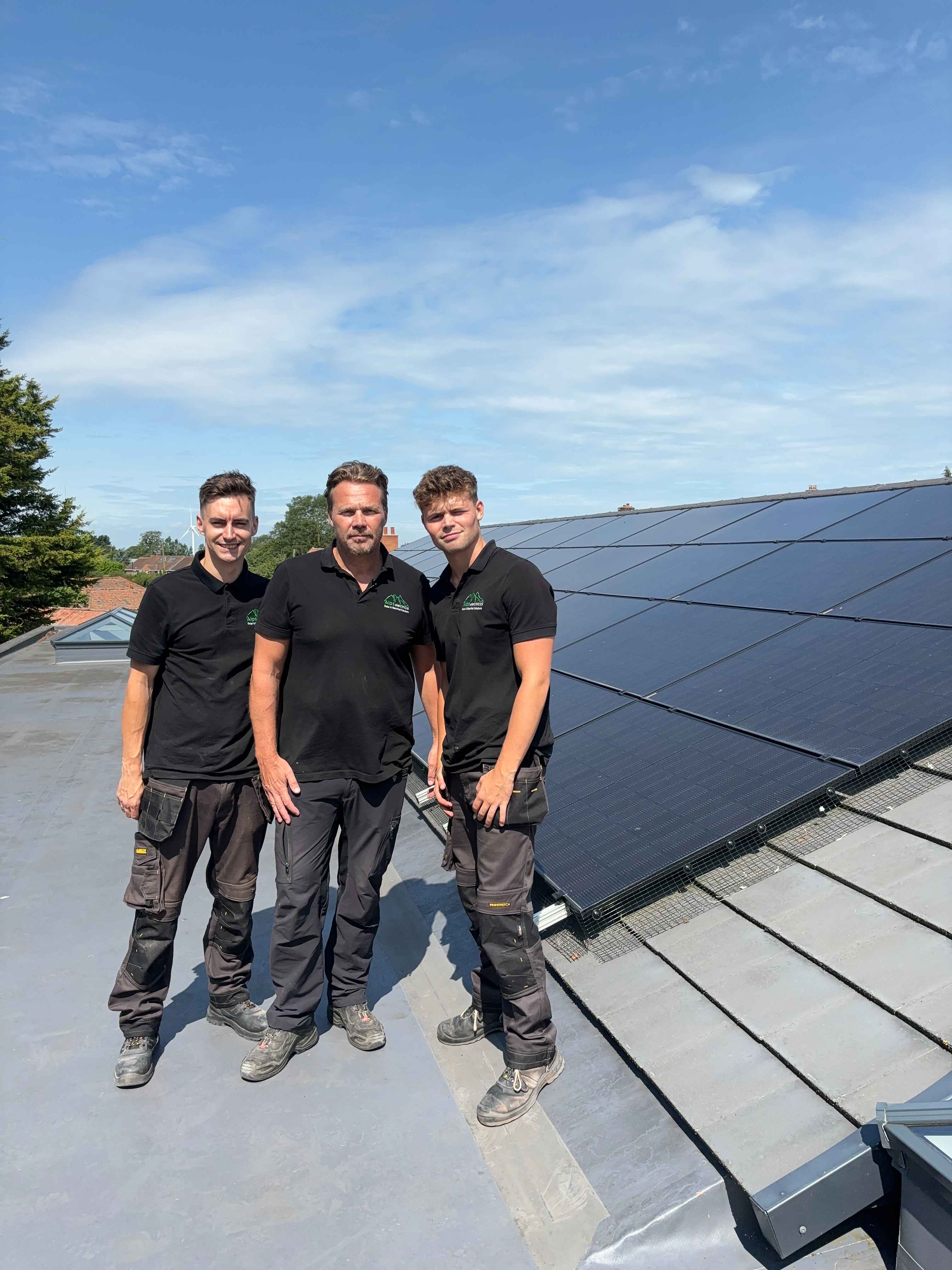
The ALPS team on a completed rooftop solar installation
Why Install Solar Panels in the North East?
1,100–1,200
kWh/m² annual irradiance
10–15%
Less than south coast
Cooler = Better
Panels more efficient in cool temps
There is a persistent myth that solar panels are only worthwhile in the south of England. This is simply not true. The North East receives approximately 1,100 to 1,200 kWh per square metre of solar irradiance annually. While this is around 10 to 15 percent less than the south coast, modern high-efficiency panels more than compensate for the difference. The cooler temperatures in the North East actually benefit solar panel performance, as panels operate more efficiently in cooler conditions than in extreme heat.
The financial case for solar in the North East is compelling. Electricity prices have risen dramatically since 2021 and remain well above historical averages. Every unit of electricity you generate and use yourself is a unit you do not have to buy from the grid. A typical 4kW system saves between 800 and 1,200 pounds per year on electricity bills, and larger systems paired with battery storage can save even more. With electricity prices forecast to continue rising, these savings grow year on year.
0% VAT on Residential Solar
Since April 2022, residential solar installations benefit from 0% VAT on panels, inverter, battery and labour. Confirmed until at least March 2027. On an £8,000 system, that is a £1,600 saving compared to the old 20% rate.
Smart Export Guarantee (SEG)
Surplus electricity exported to the grid earns you 12–15p per kWh on the best tariffs. Some tariffs like Octopus Flux offer even higher rates during peak export periods.
The Panels and Inverters We Install
Jinko Tiger Neo
One of the world's best-selling panels. Up to 22.3% efficiency with excellent low-light performance.
30-year product warranty
JA Solar
Outstanding value with efficiencies up to 21.8%. Consistently ranked among the top global manufacturers.
Top-tier reliability
Aiko
Back-contact (BC) cell architecture achieving efficiencies above 23%. Ideal where roof space is limited.
Cutting-edge technology
Inverters
The inverter is the brain of your solar system, converting DC power from your panels into usable AC electricity. We install inverters from FOX ESS, Solis, SolarEdge, GivEnergy, and Sigenergy. Each brand has its strengths. FOX ESS hybrid inverters are excellent value with reliable performance and a user-friendly app. SolarEdge uses power optimisers on each panel for maximum output on shaded or complex roofs. GivEnergy offers a complete ecosystem of inverter, battery, and energy management. Sigenergy provides a premium all-in-one solution with outstanding build quality.
During your survey, we assess your roof layout, shading conditions, electricity usage patterns, and future plans such as adding an EV charger or heat pump. This allows us to recommend the optimal panel and inverter combination for your property.
What to Expect: Our Installation Process
We have refined our installation process over hundreds of projects to ensure every customer receives a smooth, professional experience from first contact to final commissioning.
Free Survey & Quote
We assess roof orientation, pitch, condition and shading. Review your electricity bills and discuss your goals. You receive a detailed written quote with system design, projected generation, estimated savings and full cost breakdown.
Design & DNO Application
We finalise system design and submit the G98/G99 application to Northern Powergrid. G99 approval typically takes 4-12 weeks. We handle the entire process at no additional cost.
Installation Day
Takes 1-2 days. Protective sheeting, high-quality roof brackets, weatherproofed penetrations, DC cabling from roof to inverter, connection to consumer unit. Clean, methodical workmanship.
Commissioning & Handover
Full system testing, inverter configuration, monitoring app setup on your phone. MCS certification, warranty documents, DNO confirmation and operating instructions all provided.
Northern Powergrid G99 Applications
The G99 application process is a requirement for connecting generation equipment above 3.68kW per phase to the electricity grid. Northern Powergrid is the DNO for the North East and Yorkshire, and all applications go through their connections process. Many solar installers charge extra for G99 applications or leave the customer to deal with the paperwork. At ALPS Electrical, we handle the entire G99 application as part of our standard service at no additional charge.
The G99 process involves submitting detailed technical specifications of your solar and battery system to Northern Powergrid for approval. They assess whether the local grid infrastructure can support the additional generation capacity. In most residential areas of Teesside and the wider North East, approval is straightforward. In some cases, particularly in rural areas with weaker grid connections, Northern Powergrid may require a network study, which can extend the timeline. We manage all communication with Northern Powergrid throughout the process and keep you informed at every stage.
Solar Panel Savings: What Can You Expect?
| System Size | Annual Generation | Annual Savings |
|---|---|---|
| 4kW | ~3,400 kWh | £800 – £1,000 |
| 6kW | ~5,100 kWh | £1,000 – £1,400 |
| 8–10kW + battery | 6,800–8,500 kWh | £1,500+ |
Based on North East irradiance and moderate self-consumption with export tariff.
Adding battery storage significantly increases your self-consumption rate. Without a battery, a typical household uses around 30 to 50 percent of their solar generation directly. With a battery, this rises to 70 to 90 percent, dramatically reducing grid imports and maximising the value of every unit generated.
MCS Certification: Why It Matters
MCS Certification Is Essential
Without MCS certification from your installer, you cannot receive Smart Export Guarantee payments for surplus electricity. Every ALPS installation meets rigorous MCS standards for design, equipment and workmanship.
Our MCS certification is complemented by NAPIT registration (for electrical competency), TrustMark accreditation (for consumer protection), and our status as a Tesla Certified Installer. This full accreditation stack gives you complete peace of mind that your installation meets the highest standards in the industry.
Why Choose ALPS Electrical for Solar Installation?
We are a family-run business based in Yarm, Teesside, with over 375 five-star reviews on Checkatrade, 124 Google reviews, and a perfect 10 out of 10 rating. We are one of the most highly rated solar installers in the North East, and we have earned that reputation through consistent quality, transparent pricing, and exceptional aftercare.
Every installation is carried out by our own experienced team, never subcontracted. We document many of our installations on our YouTube channel, giving you full transparency into our workmanship and the systems we install. We provide genuine aftercare support, answering questions and helping with monitoring long after your installation is complete.
Whether you are considering a small 4kW system for a terraced house or a large 10kW+ system with battery storage for a detached property, we design every system to maximise your return on investment. Get in touch today for a free, no-obligation quote and discover how much you could save with solar panels from ALPS Electrical.
Ready for a Free Survey?
No obligation. One of our MCS-certified engineers will assess your roof, run the numbers, and send you a full itemised quote.
500+ five-star reviews — "Absolutely first class from start to finish. Our electricity bills have dropped by over 80% since installation." — James W., Ingleby Barwick
Brands We Install
Watch Our Installations
Areas We Cover
Related Guides
Frequently Asked Questions
A typical 4kW residential solar panel system in the North East costs between £5,000 and £7,000 including installation and VAT at 0%. Larger systems of 6-8kW range from £7,000 to £10,000. Prices vary depending on panel brand, roof complexity and whether you add battery storage. ALPS Electrical provides free, no-obligation quotes with a full breakdown of costs and projected savings.
Most UK homes need between 8 and 16 solar panels depending on electricity usage, roof size and orientation. A typical 3-bedroom semi-detached house uses around 3,500kWh per year, which can be met by a 4kW system (8-10 panels). Larger detached properties with electric vehicles or heat pumps may need 6-10kW systems (14-24 panels). We conduct a detailed survey to recommend the optimal system size for your specific needs.
Yes, solar panels work effectively in the North East. While the region receives less sunshine than the south of England, modern high-efficiency panels like the Jinko Tiger Neo and JA Solar panels we install generate significant electricity even on overcast days. The North East receives approximately 1,100-1,200 kWh/m² of solar irradiance annually. Winter output is lower but panels still generate electricity — pairing with battery storage ensures you maximise every unit generated.
A standard residential solar panel installation typically takes 1-2 days. If you are adding battery storage, this may extend to 2-3 days. Commercial installations can take 1-2 weeks depending on system size. The full process from survey to switch-on usually takes 4-8 weeks, including the DNO notification or G99 application if required.
Most domestic solar panel installations fall under Permitted Development and do not require planning permission. However, you will need to apply if your property is listed, in a conservation area, or if panels will protrude more than 200mm from the roof surface. Ground-mounted arrays over 9m² also require permission. ALPS Electrical handles all planning considerations and will advise you during the survey.
The typical payback period for solar panels in the UK is 6-9 years based on current electricity prices. With battery storage enabling you to use more of your own generated electricity, payback can be faster. After the payback period, you enjoy free electricity for the remaining 20+ years of the panel warranty. Factors affecting payback include system size, electricity usage patterns, export tariff rates and whether you have an EV or heat pump.
Solar panels remain an excellent investment in 2026. With 0% VAT on residential solar, electricity prices remaining significantly higher than pre-2022 levels, and panel efficiency continuing to improve, the financial case is strong. A typical system saves £800-£1,200 per year on electricity bills, with additional income from export tariffs. Factor in rising electricity prices and the payback period continues to shorten.
We install premium tier-1 solar panels including Jinko Tiger Neo, JA Solar and Aiko. For inverters, we are approved installers for FOX ESS, Solis, SolarEdge, GivEnergy and Sigenergy. We select the best combination for each installation based on roof layout, shading, budget and performance requirements. All brands we use come with manufacturer warranties of 25-30 years on panels.
Yes, we can arrange finance options to spread the cost of your solar installation. Finance is subject to status and terms. Contact us for current finance rates and options. Many customers find that monthly finance payments are less than their previous electricity bills, making solar effectively cash-positive from day one.
Solar panels require minimal maintenance. An annual visual inspection and occasional cleaning (if panels become dirty from bird droppings, pollen or tree sap) is usually sufficient. Inverters may need replacement after 10-15 years. We offer maintenance packages including panel cleaning, system health checks, inverter diagnostics and bird proofing. We also service systems installed by other companies.
Middlesbrough receives approximately 1,150 kWh/m² of solar irradiance annually. A 4kW solar system on a south-facing Middlesbrough roof generates 3,450-3,750 kWh per year. This is sufficient to cover the majority of a typical household's daytime electricity consumption and generate meaningful export income via the Smart Export Guarantee.
York and Harrogate receive approximately 1,100-1,200 kWh/m² of solar irradiance per year. A 4kW south-facing system in the York or Harrogate area generates 3,400-3,800 kWh annually. The Vale of York benefits from slightly lower cloud cover than the Pennines, making it one of the better solar areas in Yorkshire.
Teesside and North Yorkshire have very similar solar resource — both averaging 1,100-1,200 kWh/m² annually. A 4kW system will generate approximately 3,400-3,800 kWh per year in either region. The main variable is roof orientation and local shading, not the geographic location within the North East or North Yorkshire.
Yes. Farm solar installation is a significant part of our work. We install solar on grain store roofs, Dutch barns, livestock buildings and other agricultural structures across County Durham, North Yorkshire and Teesside. Agricultural solar qualifies for Capital Allowances, making the tax-adjusted payback period significantly shorter than domestic installations. Contact us for a free agricultural solar assessment.
It depends on the specific property. Most conservation area properties can have solar panels on non-principal elevation roofs (typically the rear) under Permitted Development. However, panels visible from the public highway on a principal elevation may require planning permission. Properties in Yarm High Street conservation area or Guisborough town centre are subject to stricter rules. We advise on planning requirements during every free survey.
Why book solar panel installation with ALPS Electrical
Most quotes for this service come from three places — regional family-run specialists (us), national MCS franchises, or sole-trader cheap quotes. Here's the trade-off.
| Feature | ALPS Electrical Family-run local | National installer e.g. franchise | Cheap quote Sole trader |
|---|---|---|---|
| MCS certified Required for 0% VAT + Smart Export Guarantee | |||
| NAPIT registered Electrical regs compliance + Building Notice | Some | ||
| Tesla Certified Installer Direct Tesla support + Powerwall stock priority | |||
| Local survey + design Owner-led, not subcontracted | Sometimes | ||
| Fixed written price No surprise extras on the day | |||
| Single installer team Same team designs + installs + commissions | Subcontracted | ||
| Same-day digital cert MCS / EICR / DNO docs by email same day | |||
| In-house aftercare One number to call for life of system | Call-centre | ||
| 500+ verified reviews Checkatrade + Google, real customers | 500+ | Mixed | Few |
| Tesla Powerwall stock Direct Tesla allocation, no 6-month waits |
ALPS Electrical
Family-run · local · Tesla Certified
- MCS certified
- NAPIT registered
- Tesla Certified Installer
- Local survey + design
- Fixed written price
- Single installer team
How we deliver every solar panel installation
A structured process refined over 500+ installations. MCS standards, NAPIT-registered team, fixed pricing — every job.
-
Free site survey
60-90 minWe visit your property, assess the existing electrical setup, take measurements and photos, and discuss exactly what you want. No commitment, no pushy sales.
-
Custom written proposal
24-48 hrsYou receive a detailed itemised quote within 24-48 hours covering system design, installation plan, fixed price and projected savings or compliance outcome.
-
Installation day(s)
1-3 daysOur NAPIT-registered installers carry out the full work. We turn up when we say we will, in branded vehicles, tidy as we go, and complete most domestic jobs in a single day.
-
Commissioning & handover
Same dayWe test every circuit, set up the monitoring app where applicable, walk you through how everything works, and hand over your certificates (MCS, NICEIC, NAPIT or DNO as applicable).
-
Lifetime aftercare
OngoingWorkmanship warranty plus manufacturer guarantees (25 years on panels, 10 years on Tesla Powerwall, 10 years on most batteries). One number to call if anything needs attention — no third-party hand-offs.
Areas ALPS Electrical cover
Award-winning, MCS & NAPIT-certified solar, battery, EV & electrical installers across Teesside, County Durham & North Yorkshire — including solar panels Darlington, solar panel installers Hartlepool, solar panel installation Durham, solar panels Redcar, solar panel installers Yarm, solar panel installation Ripon, solar panels Northallerton, solar panel installers Guisborough and solar panel installation Stokesley. Free surveys, 500+ five-star reviews, Tesla-Certified.
Reviewed & updated July 2026 by ALPS Electrical — NAPIT-registered, MCS-certified. Popular nearby: EICR testing in Northallerton, solar panel installers in York, solar panel installers in Durham.
Where we install
ALPS Electrical is based in Yarm, Teesside (TS15) and installs across Teesside, County Durham and North Yorkshire — roughly a 30-mile radius including Middlesbrough, Stockton-on-Tees, Darlington, Hartlepool, Redcar, Northallerton, Guisborough and the surrounding villages. We are not able to take on installations outside this area, so if you are further afield we would recommend finding a certified installer local to you — for a Tesla Powerwall, Tesla's own certified installer directory is the best place to start.
Solar panel installation across our 30-mile area
Solar PV is what we do most, and we install it right across Teesside, County Durham and North Yorkshire — every town below is within about 30 miles of our Yarm base, so you get a local survey, a local team and local aftercare. Choose your town for costs, output and planning specifics: Thornaby solar panel installers, solar panels Stockton-on-Tees, solar panel installers Billingham, solar panel installation Middlesbrough, Sedgefield solar panel installers, solar panels Darlington, solar panel installers Stokesley, solar panel installation Redcar, Guisborough solar panel installers, solar panels Middleton St George, solar panel installers Hartlepool, solar panel installation Newton Aycliffe, Northallerton solar panel installers, solar panels Saltburn, solar panel installers Bishop Auckland, solar panel installation Thirsk, Durham solar panel installers, solar panels Richmond, solar panel installers Yarm, solar panel installation Eaglescliffe, Ingleby Barwick solar panel installers.
Not sure which is closest? See every area we cover or our main solar panel installation service.