Tesla Certified Powerwall Installer
MCS certified, award-winning installation by ALPS Electrical. 500+ five-star reviews on Checkatrade.


Quick answer
How much does a Tesla Powerwall installation cost in the UK?
A single Tesla Powerwall 3 retrofit (existing solar) costs £8,500 installed. Combined with new 4kW solar it is £14,500, with 6kW solar £17,000, or twin Powerwall + 8kW solar £23,500. All prices include Gateway 2, commissioning, DNO notification and 0% VAT. ALPS is one of a handful of Tesla Certified Installers in the North East with direct Tesla stock allocation.
Quick answer
- Installer status: Tesla Certified Installer — one of a handful in the North East
- Storage capacity: 13.5 kWh per Powerwall 3 (stackable up to 4 units)
- Inverter: Built-in 11.5 kW — no separate string inverter needed
- Full home backup: Powers your whole home during grid outages
- UK installed price: from £8,500 (single PW3 retrofit) · £14,500-£17,000 with new solar
- Warranty: 10 years, Tesla-backed
- Areas covered: Teesside, North Yorkshire, County Durham, Tyne & Wear
Tesla Powerwall 3 Pricing in the UK
Pricing depends on whether the Powerwall is being added to an existing solar system (retrofit) or installed as part of a new solar + battery package. Single-unit retrofits where the existing inverter is being replaced by the Powerwall's built-in inverter are typically less expensive than older-style two-box installations.
| Installation type | Installed price (inc VAT) | Includes |
|---|---|---|
| Single Powerwall 3 — retrofit (no solar change) | £8,500 | Battery, Gateway 2, commissioning, DNO notification |
| Single Powerwall 3 + new 4kW solar | £14,500 | All above + 8-10 panels, scaffolding, MCS cert |
| Single Powerwall 3 + new 6kW solar | £17,000 | All above + 12-16 panels |
| Twin Powerwall 3 (27 kWh) + new 8kW solar | £23,500 | All above + 16-20 panels, dual gateway |
| Powerwall 3 expansion battery (added later) | From £4,200 | +13.5 kWh storage, no extra inverter |
Prices include 0% VAT (residential battery + solar) and standard installation up to 3 storeys. Properties needing scaffolding above 6 m or three-phase supply work are quoted individually. Updated May 2026.
Tesla Certified Installer in the North East
ALPS Electrical is one of a very small number of Tesla Certified Installers in the North East of England. Tesla Certified status is not easy to achieve. It requires rigorous technical training, ongoing assessment, and a proven track record of high-quality installations. Tesla only grants certification to installers who meet their exacting standards for workmanship, customer service, and technical competence.
Being Tesla Certified means we have direct access to Tesla's technical support team, priority access to Powerwall stock, and the ability to commission systems through the Tesla Installer Portal. It also means your Powerwall warranty is fully backed by Tesla, with the assurance that the installation was completed by a trained and approved professional. We were among the first installers in the region to complete a Powerwall 3 installation and have since fitted numerous systems across Teesside, County Durham, and the wider North East.
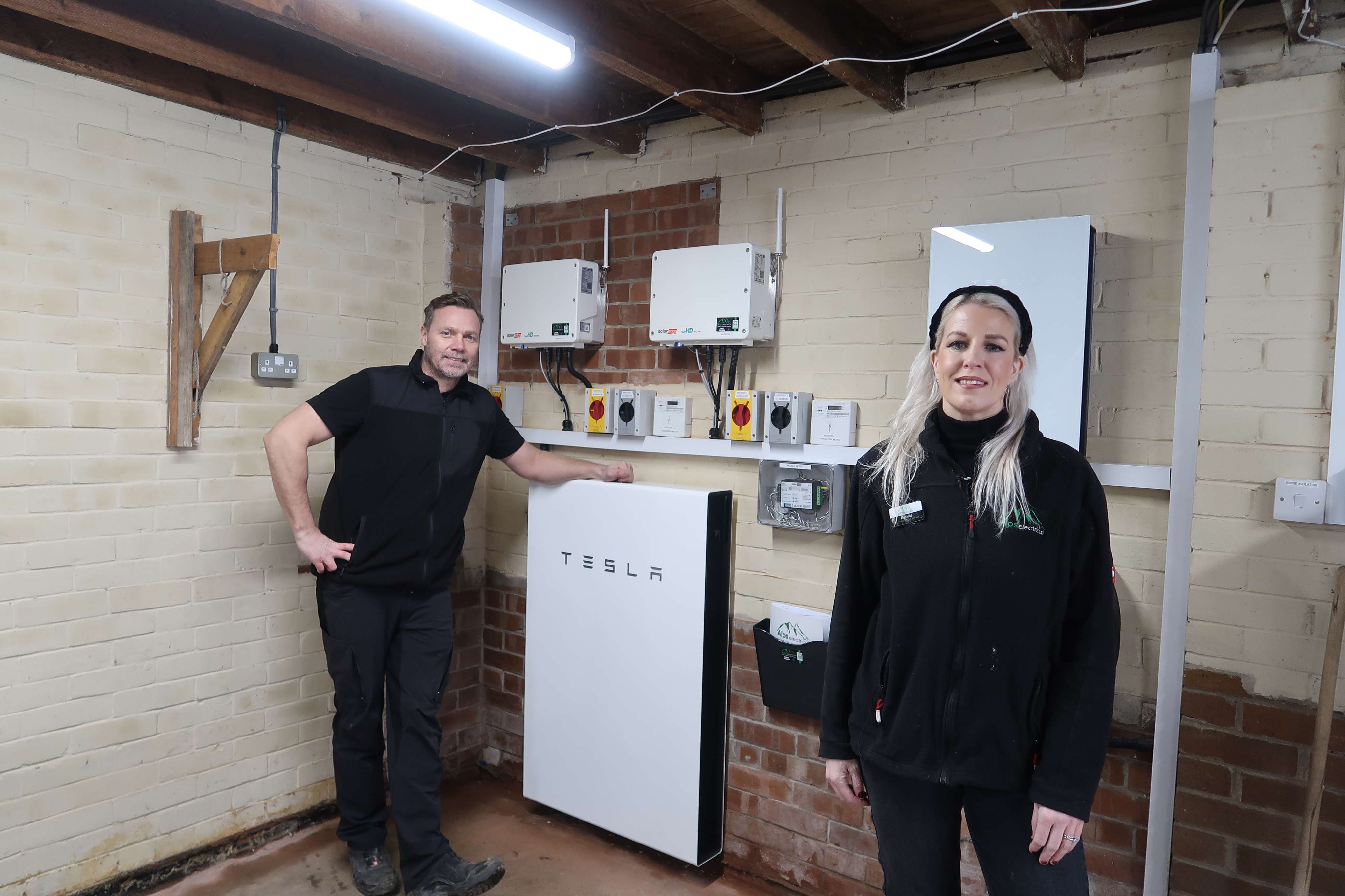
Andy and Isabella with a completed Tesla Powerwall and inverter installation
Tesla Powerwall 3: The Latest Generation
The Tesla Powerwall 3 represents a significant leap forward from its predecessor. The headline feature is the built-in solar inverter, which eliminates the need for a separate string inverter. This means fewer components on your wall, a cleaner installation, lower overall system cost, and one integrated unit managing both your solar panels and battery storage.
Key Specifications
13.5 kWh
Usable Storage
11.5 kW
Continuous Output
97.5%
Round-Trip Efficiency
4
Solar String Inputs
The increased 11.5 kW power capacity means the Powerwall 3 can comfortably handle high-demand appliances including electric cookers, heat pumps, and EV chargers. The built-in inverter supports up to 11.5 kW of solar input, making it suitable for systems of up to approximately 15 kW of panel capacity. It supports up to four solar string inputs directly, accommodating multiple roof faces and orientations without the need for additional optimisers in most cases.
Backup Gateway and Storm Watch
One of the most compelling features of the Tesla Powerwall is its ability to provide whole-home backup during grid outages. The Backup Gateway, included with every Powerwall 3 installation, automatically detects a grid failure and isolates your home from the grid within milliseconds. Your Powerwall then powers your entire home from its stored energy, and if you have solar panels, they continue generating and charging the battery even while the grid is down.
Storm Watch (Tesla Exclusive)
Monitors severe weather forecasts in your area and automatically charges your Powerwall to full capacity before storms that could cause power outages. Genuine peace of mind during North East winter storms.
Tesla Powerwall 3 vs Powerwall 2: What Changed?
The Powerwall 2 was a groundbreaking product that established Tesla as the leading name in home battery storage. The Powerwall 3 builds on that foundation with several major improvements that make it the superior choice for new installations.
| Feature | Powerwall 2 | Powerwall 3 |
|---|---|---|
| Built-In Inverter | No | Yes |
| Continuous Output | 5 kW | 11.5 kW |
| Storage Capacity | 13.5 kWh | 13.5 kWh |
| Round-Trip Efficiency | 90% | 97.5% |
| Whole-Home Backup | Limited | Full |
The Powerwall 2 required a separate solar inverter, adding cost, complexity, and an additional piece of equipment to your installation. The Powerwall 3 integrates the inverter directly into the battery unit, meaning fewer failure points, a simpler installation, and a single app controlling your entire solar and battery system. For new solar panel installations, this is a significant advantage.
The Powerwall 2 offered 5 kW of continuous output, which could struggle with simultaneous high-demand loads such as a cooker, kettle, and heat pump. The Powerwall 3 delivers 11.5 kW of continuous output, more than doubling the capacity. This makes whole-home backup genuinely practical.
The Tesla App
Both Powerwall generations use the Tesla app, which remains the best energy management app in the consumer market. The app provides real-time energy flow visualisation showing solar generation, home consumption, battery charge level, and grid import or export. You can set your energy preferences (self-consumption, time-based control, or backup reserve), monitor historical performance, and track your energy independence percentage over time. The app also provides detailed weather data and Storm Watch notifications.
Is the Tesla Powerwall Worth the Premium?
The Tesla Powerwall sits at the premium end of the home battery market. A Powerwall 3 with Backup Gateway typically costs more than a comparable GivEnergy or FOX ESS system. So is the premium justified?
Larger homes
High consumption households
Backup priority
Reliable power cuts protection
Premium product
Best-in-class app and integration
For many customers, the answer is yes. The built-in inverter reduces total system component count and simplifies the installation. The 11.5 kW continuous output provides genuine whole-home backup capability that most competitors cannot match with a single battery unit. The Tesla app is best in class. Storm Watch is unique to Tesla. And the Tesla brand carries a level of trust and recognition that gives homeowners confidence in their investment.
If budget is the primary consideration and whole-home backup is not required, alternative systems like the GivEnergy Gen 3 or FOX ESS offer excellent performance at a lower price point. We install all major battery systems and will always recommend the best solution for your specific needs, regardless of brand.
Pricing Guidance
Tesla Powerwall pricing varies depending on your specific installation requirements, including cable run distances, consumer unit configuration, and whether you are adding solar panels at the same time. As a general guide, a Powerwall 3 with Backup Gateway installed alongside a new solar panel system is more cost-effective than a retrofit installation, because the built-in inverter replaces the need for a separate solar inverter.
We provide detailed, transparent quotes for every Powerwall installation. Our quotes include all equipment, installation labour, scaffolding if required, DNO application, MCS certification, and commissioning. There are no hidden costs. We can also discuss finance options to spread the cost of your Powerwall installation over manageable monthly payments.
Tesla Powerwall Installation Process
Survey
We assess the optimal Powerwall location, cabling route, consumer unit capacity and meter setup. We discuss your energy goals, usage patterns and backup requirements.
Design & Application
System designed using Tesla's tools. G99 application submitted to Northern Powergrid. We handle all DNO paperwork and keep you updated.
Installation (2-3 days)
Powerwall and Backup Gateway wall-mounted, usually in garage or on exterior wall. If adding solar panels, they connect to the Powerwall's built-in inverter.
Commissioning
System commissioned via Tesla Installer Portal. Backup test performed. Tesla app set up on your phone. Full MCS documentation and warranty certificates provided.
11.5kW
Continuous output from a single Powerwall 3
More than double the Powerwall 2 — enough for whole-home backup
Adding a Second Powerwall
For homes with very high energy consumption, electric vehicles, or heat pumps, a single Powerwall may not provide sufficient storage. Tesla supports stacking up to four Powerwall units for a combined 54 kWh of storage. We have completed several dual Powerwall installations across the North East, providing homeowners with enough storage to achieve near-complete energy independence when combined with a large solar array.
A dual Powerwall setup also doubles the continuous power output to 23 kW, ensuring that even the most demanding home can run entirely from battery during a grid outage. This level of capability is particularly appealing for larger properties with multiple high-demand circuits.
Get a Tesla Powerwall Quote
As one of the few Tesla Certified Installers in the North East, ALPS Electrical is your local expert for Powerwall installations. Whether you want a Powerwall 3 with a new solar panel system, a Powerwall added to your existing solar setup, or a standalone Powerwall for time-of-use tariff savings, we provide a complete, professional service from survey to commissioning. Call us on 01642 790 489 or fill in the quote form for a free, no-obligation assessment.
Ready for a Free Survey?
No obligation. One of our MCS-certified engineers will assess your roof, run the numbers, and send you a full itemised quote.
500+ five-star reviews — "Absolutely first class from start to finish. Our electricity bills have dropped by over 80% since installation." — James W., Ingleby Barwick
Brands We Install
Watch Our Installations
Areas We Cover
Related Guides
Frequently Asked Questions
Battery storage costs in the UK range from £2,500 for a small 5kWh unit to £12,000+ for premium systems like the Tesla Powerwall 3 (13.5kWh). A mid-range system like the GivEnergy Gen 3 with 9.5kWh storage typically costs £4,000-£6,000. Prices include installation and are subject to 0% VAT when installed alongside or added to an existing solar panel system.
Yes, battery-only installations are increasingly popular. By charging your battery overnight on cheap tariffs like Octopus Go (7.5p/kWh) and using that stored energy during the day when rates are 24p+/kWh, you can save hundreds of pounds per year. Our Fox Cube battery-only installation video on YouTube demonstrates the savings potential in detail.
Both are excellent systems. The Tesla Powerwall 3 has a built-in inverter (simplifying installation), 13.5kWh capacity, backup gateway capability and the polished Tesla app. GivEnergy Gen 3 offers more flexible sizing, a strong community following, open API access and typically lower cost per kWh of storage. We install both and recommend based on your specific needs, budget and whether you want full home backup capability.
Modern lithium-ion solar batteries typically last 10-15 years, or 6,000-10,000 charge cycles. Tesla Powerwall comes with a 10-year warranty. GivEnergy offers a 12-year warranty on Gen 3 batteries. After warranty expiry, batteries continue to work but with gradually reduced capacity, similar to a mobile phone battery. Most batteries retain 70-80% of original capacity after 10 years.
A hybrid (DC-coupled) battery connects directly to the solar panels via a hybrid inverter, converting energy once and achieving higher efficiency (typically 95-97%). An AC-coupled battery connects to your home electrical circuit and works independently of the solar inverter, making it easier to retrofit to existing solar installations. We install both types and recommend based on whether this is a new installation or an addition to an existing system.
It depends on the battery system. The Tesla Powerwall with Backup Gateway can provide whole-home backup during grid outages. The Sigenergy system also offers full home backup. Most other batteries (GivEnergy, FOX ESS) provide backup to selected essential circuits only. Full home backup requires additional hardware and typically costs more. We can design a system to meet your specific backup requirements.
Time-of-use tariff arbitrage means charging your battery when electricity is cheapest (typically overnight at 7-10p/kWh on tariffs like Octopus Go, Intelligent Go or Flux) and using that stored energy during expensive peak periods (24-35p/kWh). This can save £300-£600 per year even without solar panels. With solar panels as well, savings can exceed £1,000 per year.
A G99 application to Northern Powergrid is required when your total inverter capacity exceeds 3.68kW per phase (single-phase) or 11.04kW (three-phase). Most residential battery and solar systems require a G99 application. The process takes 4-12 weeks and we handle the entire application on your behalf at no additional charge. Systems under 3.68kW only require a simpler G98 notification.
Octopus Flux is an electricity tariff designed for homes with solar panels and battery storage. It charges you cheaply overnight (around 8-9p/kWh) and pays you a premium export rate during peak evening periods (up to 30p/kWh). With a 9.5kWh battery charged overnight and discharged during peak, you can earn significant daily income while also benefiting from solar self-consumption during the day. We configure batteries for Flux optimisation at installation.
For most Teesside homes with existing solar, adding battery storage makes strong financial sense. A 9.5kWh battery typically adds £400-£600 per year in additional savings by increasing self-consumption from 40-50% to 75-85%. Payback on the battery alone is typically 8-11 years. If you are also switching to a smart tariff like Octopus Go or Flux, the financial case improves further.
Why book tesla powerwall installer with ALPS Electrical
Most quotes for this service come from three places — regional family-run specialists (us), national MCS franchises, or sole-trader cheap quotes. Here's the trade-off.
| Feature | ALPS Electrical Family-run local | National installer e.g. franchise | Cheap quote Sole trader |
|---|---|---|---|
| MCS certified Required for 0% VAT + Smart Export Guarantee | |||
| NAPIT registered Electrical regs compliance + Building Notice | Some | ||
| Tesla Certified Installer Direct Tesla support + Powerwall stock priority | |||
| Local survey + design Owner-led, not subcontracted | Sometimes | ||
| Fixed written price No surprise extras on the day | |||
| Single installer team Same team designs + installs + commissions | Subcontracted | ||
| Same-day digital cert MCS / EICR / DNO docs by email same day | |||
| In-house aftercare One number to call for life of system | Call-centre | ||
| 500+ verified reviews Checkatrade + Google, real customers | 500+ | Mixed | Few |
| Tesla Powerwall stock Direct Tesla allocation, no 6-month waits |
ALPS Electrical
Family-run · local · Tesla Certified
- MCS certified
- NAPIT registered
- Tesla Certified Installer
- Local survey + design
- Fixed written price
- Single installer team
How we deliver every tesla powerwall installer
A structured process refined over 500+ installations. MCS standards, NAPIT-registered team, fixed pricing — every job.
-
Free site survey + energy review
60-90 minWe visit your home, check your existing consumer unit + roof + tariff, and confirm whether Powerwall 3 retrofit or PW3 + new solar is the right route for you.
-
Custom Tesla system design
48 hrsSized to your annual kWh usage, peak load (kettle + oven + EV charger), and backup priorities. Includes Tesla Gateway 2 wiring diagram.
-
Installation by Tesla-certified team
1-3 daysTwo-person install, typically completes in 1 day for retrofit, 2-3 days when combined with new solar. All cabling concealed where possible.
-
Tesla Portal commissioning
Same dayDirect connection through the Tesla Installer Portal — your Powerwall warranty is backed by Tesla, not us. You receive the Tesla app + DNO notification + MCS certificate same day.
-
10-year Tesla warranty + lifetime aftercare
OngoingTesla 10-year manufacturer warranty on the Powerwall. ALPS lifetime aftercare for the install workmanship — one number to call if anything needs attention.
Areas ALPS Electrical cover
Award-winning, MCS & NAPIT-certified solar, battery, EV & electrical installers across Teesside, County Durham & North Yorkshire — including solar panel installers Hartlepool, solar panel installation Durham, solar panels Redcar, solar panel installers Yarm, solar panel installation Ripon, solar panels Northallerton, solar panel installers Guisborough, solar panel installation Stokesley and solar panels Thornaby. Free surveys, 500+ five-star reviews, Tesla-Certified.
Tesla Powerwall Certified Installer — North East
ALPS Electrical is a Tesla Certified Installer — one of roughly 50 in the UK — covering Teesside, County Durham and North Yorkshire. Only a Tesla Certified Installer can supply, install and register the warranty on a Powerwall 3, so choosing certified protects your investment.
Can any electrician install a Tesla Powerwall 3?
No. Tesla only allows accredited Tesla Certified Installers to buy, fit and commission Powerwall 3 — and only a Certified Installer can register the 10-year warranty through the Tesla portal. There are only around 50 Tesla Certified Installers in the whole UK. ALPS Electrical is one of them, covering Teesside, County Durham & North Yorkshire.
What does Tesla Certified Installer mean, and how do I check?
Tesla Certified Installers complete Tesla's technical training and are listed on Tesla's official Find a Certified Installer tool. Using a certified installer guarantees a compliant install, a genuine Tesla warranty and correct Tesla app/portal commissioning. Always confirm certification before you buy — a non-certified fit can void the warranty.
How much does a Tesla Powerwall 3 cost installed in the North East?
A single Powerwall 3 (13.5 kWh) is typically £8,500–£10,500 fitted at 0% VAT, more for twin-Powerwall or solar-plus-Powerwall systems. ALPS give a fixed written price at a free survey — no obligation.
Is the Tesla Powerwall 3 worth it?
For most North East homes with solar or a time-of-use tariff, yes: the Powerwall 3 has a built-in solar inverter, 11.5 kW continuous output, whole-home backup and a 10-year warranty, and typically saves £700–£950 a year while keeping the lights on in a power cut.
Reviewed & updated July 2026 by ALPS Electrical — NAPIT-registered, MCS-certified. Popular nearby: EICR testing in Northallerton, solar panel installers in York, solar panel installers in Durham.
Tesla Powerwall 3 vs the alternatives we also install
Unlike single-brand installers, ALPS fit Tesla, GivEnergy and Fox ESS — so our recommendation is based on your home, not our stock. How they compare:
| Battery | Usable capacity | Backup output | Warranty | Typical fitted price | Best for |
|---|---|---|---|---|---|
| Tesla Powerwall 3 | 13.5 kWh | 11.5 kW (whole-home backup, built-in solar inverter) | 10 years | £8,500–£10,500 | Whole-home backup, EV owners, one-box solar+storage |
| GivEnergy (Gen 3) | modular, typically 9.5 kWh | partial backup via EPS | 12 years | from ~£4,500–£6,500 installed | Value storage on a budget, UK-based support |
| Fox ESS (Cube) | stackable modules (expandable) | partial/whole-home options | 10 years | from ~£5,000–£8,000 installed | Expandable capacity, pairing with larger solar arrays |
Indicative installed prices at 0% VAT, correct Jul 2026 — exact quote after a free survey.
Deep dives: GivEnergy vs Tesla Powerwall · full Powerwall 3 review · Powerwall 3 vs Powerwall 2.